Last updated June 2026. Debate schedules and visiting conditions can change — confirm on the morning of your visit.
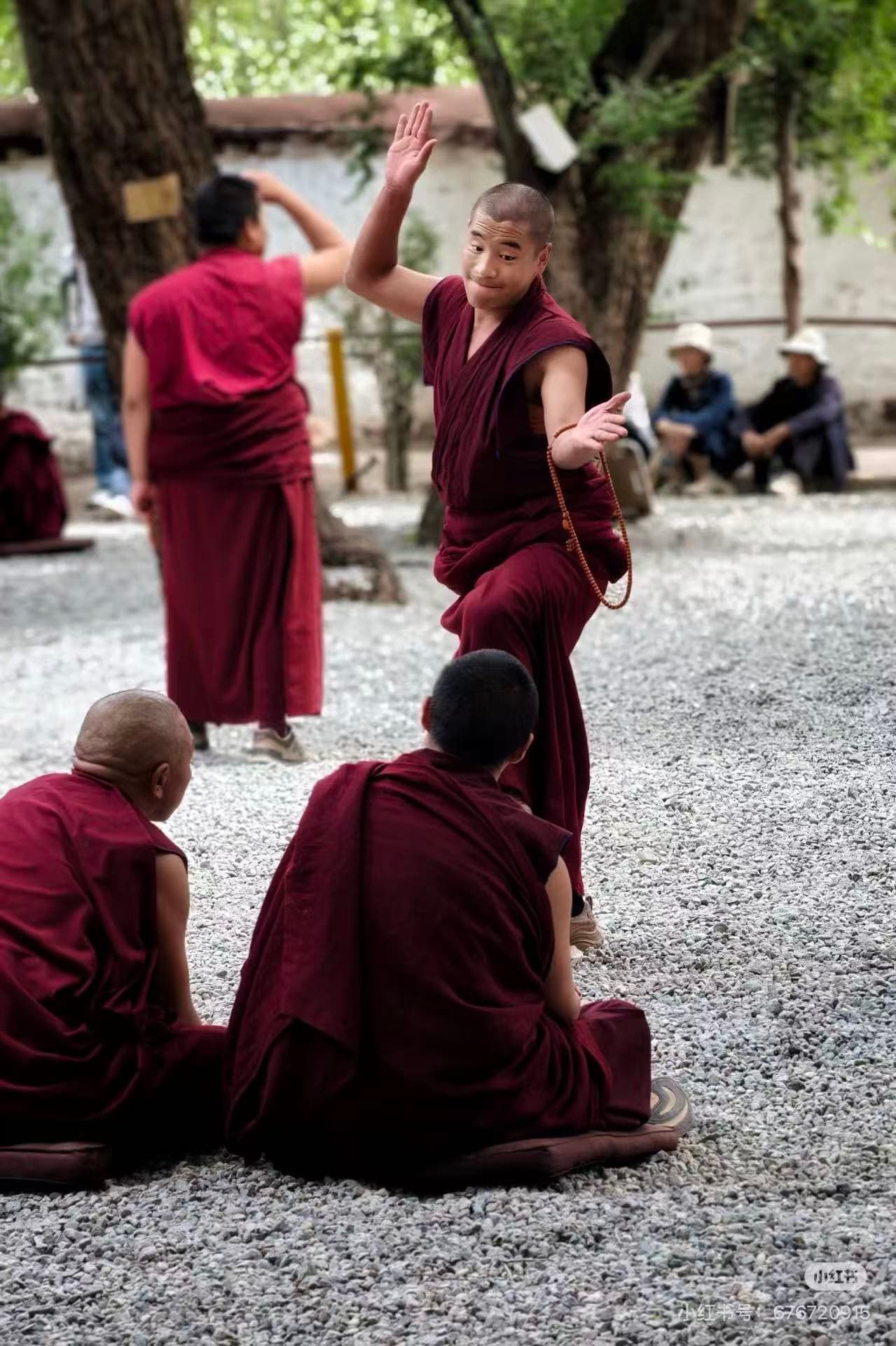
The first thing you notice entering the debate courtyard is the sound: sharp clapping, coming from all directions at once. Then the movement. Monks in dark red robes fill a stone-paved courtyard shaded by old trees — hundreds of them, arranged in pairs across the open space. In each pair, one monk stands and one sits. The standing monk brings both hands together with a crack, extends one arm forward, then waits. The sitting monk responds. The exchange continues. Beside them, another pair is doing exactly the same thing. So is every pair in the courtyard, all at once, independently, for two hours.
Nothing about this looks the way most visitors expect. The image many people carry is of a formal debate between two senior figures — measured, quiet, ceremonial. Sera Monastery's debate courtyard is alive, loud, and completely serious. For anyone interested in religious culture, it is one of the most striking things you can see in Lhasa.
What You're Actually Watching
The debates at Sera Monastery are not a performance put on for visitors. They are a core part of how monks here are educated and assessed.
Sera was founded in 1419 and is one of three great Gelug monasteries in Lhasa. Monks begin training from around age eight and work through a curriculum covering Buddhist philosophy texts over many years — the equivalent of a lengthy graduate programme. Before a monk can advance to the next stage of study, he must be able to defend his understanding in debate. The afternoon sessions are part of that ongoing process.
The topics being argued — the nature of emptiness, the definition of compassion, the stages leading to enlightenment — are the central questions of Tibetan Buddhist philosophy. Visitors who speak no Tibetan (which is most of them) will not follow the arguments. This does not diminish the experience. The form of the debate is what carries it: the structure, the gestures, the rhythm of challenge and response.
The Layout of the Courtyard
Visitors enter the debate courtyard and are expected to stay along the edges. The inner space belongs to the monks. Staying at the perimeter gives a clear view across the whole courtyard, which is where the scale of simultaneous debates becomes apparent.
There are two distinct areas worth finding. The main area holds younger monks — teenagers through to men in their twenties — who are working through their standard curriculum. This is the louder, denser section. Along one side or a separate corner of the complex, a smaller group of senior monks conduct higher-level debates. There are far fewer of them. The pace is slower and the gestures more deliberate, which makes it easier to follow individual exchanges.
Spending time in both areas is worth it. The senior section is often overlooked by visitors who settle into one spot in the main area and stay there.
What the Gestures Mean
The gestures are the part of the debate that visitors ask about most. Each one carries a specific symbolic meaning in Gelug tradition, and understanding them changes what you see.
The clap. Only the standing monk (the challenger) claps. The right hand, which represents skillful means and compassion, comes down onto the left hand, which represents wisdom. The clap together signifies the union of the two. On a practical level, it signals the end of a question and puts pressure on the seated monk to respond quickly.
The stomp. The left foot comes down firmly on the ground at the same moment as the clap. This gesture symbolises closing the door to lower realms of rebirth — driving away negative consequences with each exchange.
The arm extension. After clapping, the challenger typically extends the left arm forward and raises the right arm holding prayer beads. The left arm extended represents a wish for all beings to be freed from suffering; the raised beads represent compassion extended toward them.
"Tsa!" When a line of argument has been definitively closed — when the defender can no longer sustain a position — the challenger shouts this word. Three consecutive shouts of "Tsa!" means the defender has lost the core point being argued. If you hear this, something significant has happened.
Once you know these four elements, the visual language of the courtyard starts to resolve. What looks like a crowd of people gesturing randomly becomes a series of structured, simultaneous exchanges — each pair working through their own argument at their own pace.
When to Go and How to Get There
Debate times: Sessions run approximately 3:00 pm to 5:00 pm, Monday through Saturday. The debates do not run on Sundays. They are also occasionally cancelled on major religious holidays. Confirm on the morning you plan to visit — hotel front desk staff can usually tell you, or contact your travel agency.
Arrive by 2:30 pm. The courtyard fills up from around 2:45 pm as both monks and visitors gather. Arriving thirty minutes early allows time to find a good position along the edge. The closer to the centre, the better the view — but stay out of the monks' space.
Morning visit. The monastery opens at 9:00 am and closes at 4:00 pm. The morning is a good time to walk the complex at a different pace: the three colleges (Sera Je, Sera Me, and Ngakpa Dratsang) each have courtyards, chapels, and passageways worth exploring. Photography is not permitted inside the chapels. A practical full-day schedule: arrive at 10:00 am, spend 1.5 hours on the grounds, find somewhere to eat nearby, and return by 2:30 pm for the debates.
Getting there: Sera Monastery is approximately 4–5 kilometres north of the Barkhor Street area. A taxi takes 15–20 minutes and costs approximately ¥20–30. There is no direct tourist bus from the city centre. Tell the driver "Sera Monastery" or show the location on a map. The entrance is on the south side of the complex.
What Goes Wrong
Arriving on a Sunday. The most common disappointment. Visitors who don't check the schedule arrive to find a quiet courtyard with no activity at all. Confirm on the morning of your visit, every time.
Bringing a professional camera. Smartphones are permitted in the debate courtyard. Cameras with interchangeable lenses are not — staff at the entrance will ask you to leave them. Afternoon light in the courtyard is generally good enough for phone photography.
Walking into the debate area. The edges of the courtyard are for visitors; the interior is where the monks work. Stepping into the middle of the debate space interrupts ongoing exchanges and will draw attention from staff. Find a spot at the edge and stay there.
Leaving in the first few minutes. Many visitors who don't immediately understand what they're seeing leave within five minutes. The experience changes significantly after ten to fifteen minutes, once the gesture vocabulary becomes recognisable. Staying for at least thirty to forty minutes — and spending some of that time watching the senior monks' section — makes the visit considerably more worthwhile.
Treating it as a tourist show. The debates continue whether visitors are present or not. Loud conversation, attempts to interact with the monks mid-debate, or crowding around individual pairs all disrupt what is, for the monks, a serious academic activity. Keep a respectful distance, stay quiet while exchanges are happening, and observe rather than engage.
Practical Information
| Item | Details |
|---|---|
| Admission | ¥55 (covers full monastery access, including debates) |
| Opening hours | 9:00–16:00 daily |
| Debate session | Approximately 15:00–17:00; arrive by 14:30 |
| Debate days | Monday to Saturday; closed Sunday; occasional cancellations on religious holidays |
| Confirming debate days | Ask hotel front desk or travel agency on the morning of your visit |
| Getting there | Taxi from Barkhor Street area, 15–20 min, approximately ¥20–30; show map or say "Sera Monastery" |
| Photography | Smartphones permitted in debate courtyard; professional cameras with interchangeable lenses are not |
| Language | Debates are conducted entirely in Tibetan; no translation available on-site |
| Dress | No strict requirements; avoid shorts and sleeveless tops |
| English on-site | Limited; the monastery has no official English audio guide |
The debate sessions at Sera Monastery are one of the few places in Lhasa — or anywhere — where visitors can observe something genuinely functional from the outside: not a recreation, not a performance scheduled for tourism, but a practice that has been running daily for centuries and that the monks here depend on for their own advancement. Language is not the barrier most people assume it will be. The form carries the experience well enough on its own.
Things to Do in Lhasa · Lhasa Travel Guide · Tibetan Culture Guide for Visitors · Lhasa Safety Guide