Opening
Jiuzhaigou is not a dangerous destination. The park has well-maintained walkways, a controlled shuttle bus system, and medical stations at major viewpoints. Most visitors complete the circuit without any issues beyond sore legs.
Two things catch people off guard: the altitude and the weather. The park sits between 2,000 and 3,100 meters above sea level, and most visitors arrive directly from low-elevation cities with no acclimatization time. If your itinerary includes Huanglong, that site sits between 3,500 and 3,900 meters — a significant step up. This guide covers what to prepare for, what to watch for, and how to handle it if something goes wrong.
Altitude
What to Expect
On arrival day, mild headache, slight breathlessness, and fatigue are normal. Most visitors feel noticeably better after one night's sleep. These symptoms don't require intervention beyond rest, water, and a slower pace.
Symptoms that require immediate descent:
- Breathlessness at rest — not from exertion, but while sitting or standing still
- Severe persistent headache that doesn't respond to standard pain relief
- Confusion, disorientation, or unusual behavior
- Inability to walk normally
These are warning signs of serious altitude illness. Do not wait to see if they improve. Get to lower elevation and seek medical care.
Your First Day in the Park
Walk slowly. The park's wooden walkways are mostly flat; the altitude gradient is gradual across the main valley circuit. There is no need to rush to the first shuttle stop or match the pace of a tour group.
Drink more water than you think you need — dehydration accelerates at elevation. Bottled water is available inside the park at a premium; bring some from Zhangzha Town.
Avoid alcohol on your first day. It amplifies altitude symptoms.
Acetazolamide (Diamox)
If you have a history of altitude sensitivity or are traveling from sea level with no time to acclimatize, consult a doctor before departure about acetazolamide (Diamox). It requires a prescription and is not available inside the park. The most reliable approach is to sort this before leaving your home country. If you are already in China, major hospitals in Chengdu (such as West China Hospital / Huaxi Yiyuan) can issue a prescription, but the process involves registration and a consultation appointment — budget time for it.
Huanglong: A Different Calculation
Huanglong sits 400 to 800 meters higher than Jiuzhaigou, and its main viewpoints are concentrated at the upper elevation. Visitors who go straight from Jiuzhaigou to Huanglong regularly underestimate this difference.
Free oxygen is available at the entrance to Huanglong. If you feel unwell, use it — there is no reason not to. Do not schedule both parks on the same day. Treat Huanglong as a full separate day with time built in to move slowly.
The 2017 Earthquake
A magnitude 7.0 earthquake struck Jiuzhaigou in August 2017, causing significant damage and closing the park. Infrastructure was assessed and repaired, and the park reopened to visitors in 2019. The currently open sections of walkway and the shuttle bus system have passed safety inspection. The earthquake is not an active safety concern for visitors today.
If you see sections marked as temporarily closed, this typically indicates seasonal maintenance or localized repair work — not earthquake damage.
Inside the Park
Mobile Signal and Offline Maps
Signal is unreliable in the upper valleys — the area around Long Lake and the Old Forest trail has patchy to no coverage. Download an offline map before entering the park. Maps.me and Amap (Gaode International) both cover the area; search "Jiuzhaigou" in the app and download the offline region. Do not rely on real-time navigation inside the park.
Weather
Morning-to-afternoon temperature swings of 10 to 15°C are normal in spring and autumn. Pack a compressible windproof layer regardless of the forecast. After rain, the wooden walkways become slippery — particularly on steps. Slow down.
Walkway Rules
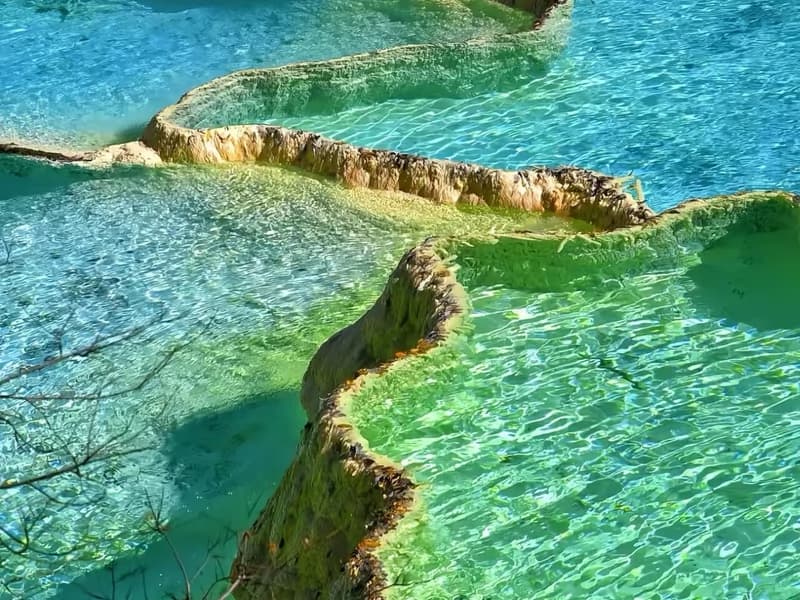
All movement in the park is confined to designated walkways. Entering the water, collecting plants, or leaving the path into forested areas is prohibited. Rangers patrol regularly and enforcement is consistent. Violations can result in fines in addition to removal from the park. The travertine geology that creates the lake colors is fragile; disturbance affects the entire ecosystem downstream.
If You Need Help
Medical stations with oxygen are located near Five Flower Lake, Nuorilang Service Center, and Long Lake.
Park emergency line: 0837-7739753
China national emergency: 120 (ambulance)
If your phone signal is weak, find the nearest shuttle bus driver or park staff member. They carry two-way radios and can reach the park's response team faster than a phone call.
Valuables
Theft targeting foreign visitors is not a notable problem inside Jiuzhaigou. In the busy transfer areas — particularly Nuorilang Service Center and the main shuttle bus queues — keep bags in front of you during peak season crowds. Don't carry your passport and all your cash in the same place. In the Zhangzha Town area outside the park, standard city-level awareness applies.
Closing
Altitude is the one thing worth taking seriously before you arrive. Everything else — weather, walkway rules, connectivity — is manageable with basic preparation. Walk slowly on day one, download your maps before you enter, and bring a warm layer. The park is well-organized and its staff handle foreign visitors every day.
If you're adding Huanglong to your itinerary, give it a separate day and treat the altitude difference as a real variable, not a footnote.
Related guides: